
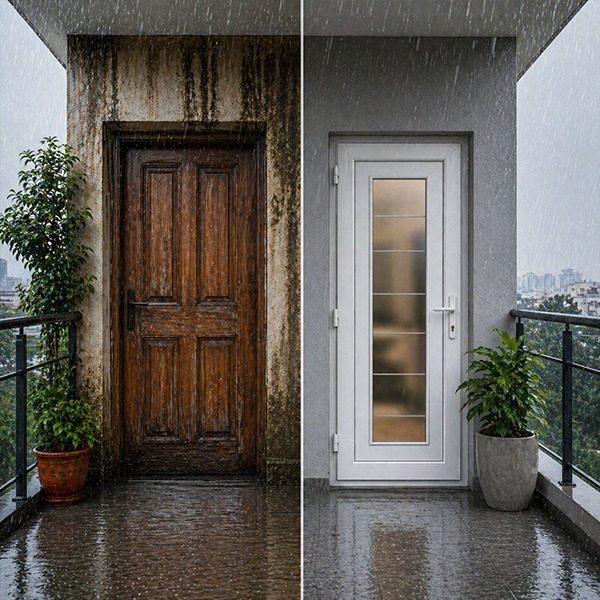
Indian Weather Ruining Your Doors? uPVC vs Wooden Doors Truth Revealed
If you live in India, you already know how unpredictable the weather can be. One season feels completely different from the next. Summers get extremely hot, monsoon brings heavy moisture, and winters in some places turn quite dry. We adjust to it, but our home materials don’t always handle it as easily.
Over time, small door issues start showing up. You might notice the door not shutting smoothly. Sometimes the surface starts looking dull or slightly swollen. At first, you ignore it. Later, it starts bothering you in daily use.
That’s when most people begin to think. Should they continue with wooden doors, or is it better to shift to something more practical like uPVC?
Let’s break it down in a simple way.
How Indian Weather Affects Wooden Doors
Wood has always been a popular choice in homes. It looks rich and gives a classic feel. But the problem is, wood reacts to the environment around it.
During monsoon, wood absorbs the moisture in the air and because of this it tends to get bigger in size. You may feel this when your door starts getting tight or a bit difficult to close.
Later, when the weather becomes dry, the opposite happens. The same wood loses that moisture and shrinks a little. This often leads to little spaces left around the edges.
At first, these changes look quite normal. But over some time, it starts to affect how the door fits and works.
There is also another issue of surface damage. Continuous exposure to heat and moisture can affect the finish. You may see bending or uneven areas.
Because of these reasons, wooden doors usually need regular care to stay in good condition.
Termites and Moisture Problems
Another common and quite major concern with wood is termites. Many homeowners have faced this issue at some point in their life.
Even after treatment, there is always a risk. Especially in places where moisture is present and with time the strength of the wood can reduce if not taken care of properly.
Water exposure adds to the problem. Repeated contact with moisture weakens the material slowly.
These are not sudden changes, but they do show up clearly after a few years.
What Makes uPVC Doors Different
Now let’s look at how uPVC behaves in the same conditions.
Unlike wood, uPVC does not take in moisture. So it does not expand during monsoon or shrink in dry weather.
Its shape stays the same. The fitting does not change.
This avoids problems like doors getting jammed or gaps starting to appear around the frame.
Another benefit is that termites do not affect uPVC at all. Since it is not a natural material, pests do not damage it.
This removes a major concern for homeowners.
Performance in Heat and Rain
Indian summers can be quite harsh. Continuous heat affects many materials, but uPVC handles these conditions without much trouble in day-to-day use.
It does not easily lose its shape under normal temperature changes.
During monsoon, when humidity is at its high, the uPVC remains stable. It does not absorb water and does not get weak.
This makes it suitable for areas where exposure is higher, like balconies, bathrooms, or main doors.
Maintenance Differences
This is where the difference becomes very clear.
Wooden doors need attention from time to time. Polishing may be required. Repairs may be needed if the surface gets damaged. Hinges may also need fixing if the door shape changes slightly.
If this is ignored, the condition can worsen faster.
uPVC doors are much simpler in comparison. They do not need polishing. Cleaning is easy. A quick wipe is usually enough.
There is no regular maintenance cycle involved, which makes life easier.
Daily Use and Practical Comfort
Think about daily use. Doors are opened and closed many times in a day. If a door starts sticking or making noise, it becomes irritating very quickly.
Wooden doors may feel smooth in the beginning, but weather impact can change that over time.
uPVC doors feel the same even after long use. They continue to open and close easily because their structure does not shift much unlike wooden doors.
This consistency makes everyday use more comfortable.
Appearance and Modern Homes
Many people still prefer wood because of its traditional look.
But today, uPVC designs have also improved. Some finishes even give a wood-like appearance.
At the same time, home design trends are changing. People now prefer simple and less bulky interiors.
uPVC fits well in such spaces because of its neat and minimalist look.
Long-Term Value
At first glance, wooden doors may seem like a strong investment.
But over time, maintenance becomes a major factor. Polishing, repairs, and termite treatments add to the cost.
uPVC doors do not demand this level of attention. Once installed, they keep on working without much intervention.
So while wood may feel like a traditional choice, uPVC often makes more sense when you think long-term.
Which One Makes More Sense Today
Wood still works for people who prefer a classic style and are ready to maintain it regularly.
But when you look at real conditions like Indian weather and daily usage, in such situation practical factors matters alot.
uPVC offers you with stability, less maintenance, and better consistency.
It simply reduces the small problems that turn into big frustrations later.
The Role of the Right Choice
Choosing a door is not just about how it looks on day one. It is about how it performs over time.
At Dhabriya Polywood, the idea is simple. A product should work well in real homes, not just look good in a showroom.
When people understand how materials behave across seasons, their decisions become easier.
Conclusion
Indian weather keeps changing, and materials that cannot adjust to it start showing problems.
Wooden doors look good, but they need regular care to stay in shape.
uPVC doors offer a better practical option for you. They handle weather better, they require less effort to maintain, and they stay consistent in daily use.
In the end, it is not about old habits or new trends. It is about choosing what actually works better for your home.
And sometimes, a simple switch can make daily living much more comfortable.