
PVC Wall Panels vs Tiles: Do PVC Wall Panels Actually Look More Expensive—and Are They Better?
A polished wall finish can completely change a bathroom, living room, or commercial interior. That is why many homeowners in Jaipur are comparing PVC wall panels vs tiles before renovating. Modern PVC panels can imitate wood, stone, marble, and textured finishes while avoiding some of the installation and maintenance demands of tiled walls. But “better” depends on where the material is used and what matters most to the owner. For projects where speed, moisture resistance, easy cleaning, and a contemporary look are priorities, PVC wall panels can be a very practical alternative. Tiles still make sense when a ceramic or porcelain finish, high impact hardness, or classic tile design is the main goal.
Are PVC wall panels better than tiles?
PVC wall panels can be better than tiles for many wall applications, but they are not universally superior. Their key advantages are a non-porous surface, low routine maintenance, faster installation, and design flexibility. Tiles can be preferable where a very hard surface, traditional ceramic appearance, established tiling methods, or specific tile formats are more important.
What are PVC wall panels?
PVC wall panels are rigid polyvinyl chloride panels used as an interior wall covering. They can have smooth, decorative, fluted, wood-inspired, or stone-inspired finishes. Dhabriya Polywood describes its PVC wall panels as non-porous and non-absorbent, with resistance to water, moisture, and chemicals; the company lists homes, offices, hotels, restaurants, and other commercial spaces among their applications.
For Jaipur properties, this makes PVC panels useful for bathrooms, utility areas, feature walls, offices, hospitality interiors, and renovation projects where owners want a visual upgrade without extensive demolition.
PVC wall panels vs tiles: what really matters
1. Appearance and design
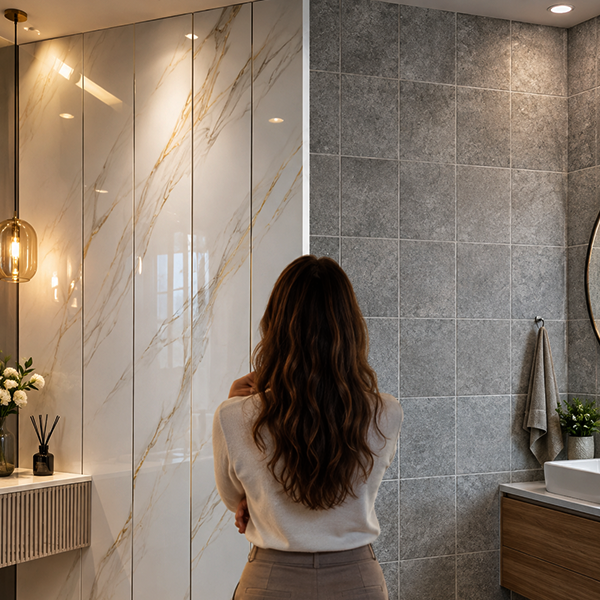
The “expensive” look usually comes from visual continuity. Large-format-looking surfaces, marble-inspired patterns, wood tones, and fluted textures can create a cleaner visual field than smaller tiles separated by frequent grout lines. Polywood’s current range includes PVC wall and ceiling panels, Muraux luxury panels, and fluted panels in different finishes and shades.
Tiles still win when you specifically want the authentic feel of ceramic or porcelain, detailed tile patterns, or familiar stone-look formats. In a premium interior, lighting, joint alignment, edge finishing, and installation quality can matter as much as the material itself.
2. Waterproofing and moisture resistance
PVC has a practical advantage because the material itself is non-porous. Polywood specifically positions its PVC wall panels for moisture-prone environments and describes them as water- and moisture-resistant.
However, a waterproof panel does not automatically make a bathroom completely waterproof. Moisture can still reach vulnerable areas through joints, corners, pipe penetrations, cut-outs, or a poorly prepared substrate. Tiled bathrooms have a similar system-level issue: tile and grout are not inherently waterproof, so the underlying waterproofing system and detailing are important.
This distinction matters when evaluating waterproof wall panels. Always assess the complete installation system rather than assuming the surface material alone prevents leaks.
3. Installation and renovation speed
For renovation work, PVC panels often win on convenience. They are lightweight and can be cut and fabricated with conventional tools. Polywood also states that its panels can be uninstalled when required.
Tiling generally involves more site preparation, setting-out, cutting, adhesive or mortar work, grouting, and drying or curing time. The actual project duration varies with wall condition, tile size, labour, and site complexity, so fixed “one-day versus three-day” claims should not be treated as universal.
This difference can be particularly useful when a homeowner wants to upgrade an existing bathroom or commercial space while keeping demolition, dust, and disruption under control.
4. Maintenance
This is one of the strongest reasons to consider PVC bathroom wall panels. A non-porous surface is easy to wipe, and panel systems can reduce the amount of grout exposed to everyday dirt and moisture. Polywood describes its panels as easy to clean and low maintenance.
Tiles can also be straightforward to maintain, especially quality glazed surfaces. However, grout lines and sealant joints may require more attention over time. For homes, rental properties, offices, hotels, and busy commercial spaces, easier routine cleaning can have real practical value.
5. Durability and repair
Tiles provide a hard, mineral-based surface, but individual pieces can chip or crack under impact. Replacement can also be complicated when a particular design is no longer available. PVC panels are lighter and suitable for normal interior use, but they should not be treated as impact-proof or structural wall material.
The better question is therefore: what does the room demand? For decorative and moisture-exposed interior walls, PVC can offer useful performance. For locations where maximum surface hardness matters, tiles may remain the better fit.
Is PVC cheaper than tiles in Jaipur?
PVC can be more economical overall in some renovation projects, but there is no universal price winner. Total cost depends on the panel or tile selected, wall condition, accessories, labour, demolition, surface preparation, wastage, and installation method. Comparing only the material price per square foot can therefore give a misleading result.
For a fair cost comparison, include surface preparation, fixing materials, grout where applicable, trims, wastage, labour, demolition, debris removal, and expected maintenance. A complete installed quotation from suppliers is more useful than comparing panel price with tile price alone.
Where do PVC panels make the most sense?
PVC panels are especially suitable for bathroom and utility walls, feature walls, office interiors, hospitality spaces, and renovation projects where speed and low maintenance matter. Polywood lists both residential and commercial applications across its panel ranges.
For a premium decorative statement, Muraux luxury wall panels fit projects where a richer patterned finish is the priority. For a contemporary architectural effect, wall and ceiling fluted panels offer a textured option for homes, offices, hotels, and similar spaces.
When should you still choose tiles?
Tiles are a strong choice when the design specifically calls for ceramic or porcelain, when you need a very hard surface, or when the project depends on tile formats, patterns, borders, or established tiling methods. BIS lists IS 15622:2017 as the Indian Standard for pressed ceramic tiles.
The biggest mistake is treating the decision as a simple material contest. Define the room, moisture exposure, impact level, appearance, renovation constraints, and maintenance expectations first. Then compare complete wall systems.
A practical buying checklist
Before ordering, inspect a physical sample. Confirm thickness, finish, intended application, fixing method, compatible accessories, joint treatment, cleaning guidance, and warranty terms. Check the wall condition too: persistent seepage should be diagnosed and repaired rather than simply covered.
For a broader product review, PVC wall and ceiling panels is a useful place to explore Polywood’s range.
Conclusion
So, are PVC wall panels actually better than tiles? In many Indian renovation projects, they can be the smarter wall finish—not because tiles are outdated, but because PVC solves a different set of problems. Its strongest case is where you want a modern appearance, moisture resistance, easier cleaning, and less disruptive installation. Tiles remain excellent where ceramic performance and a traditional tiled aesthetic are priorities. In Jaipur, choose based on the room, substrate, design, and total installed cost—not simply on which sample looks most luxurious.
FAQs
1. Are PVC wall panels better than tiles for bathrooms?
PVC panels can be a practical bathroom choice because their surface is non-porous, moisture-resistant, and easy to clean. The complete installation still needs properly sealed joints, corners, penetrations, and suitable substrate preparation.
2. Do PVC wall panels look as good as tiles?
Modern PVC panels can create premium-looking interiors with marble, wood, fluted, and textured finishes. Their appearance depends heavily on the design, installation quality, trims, lighting, and overall interior scheme.
3. Are PVC wall panels waterproof?
Many PVC wall panels are designed to resist water and moisture, but the entire wall assembly is not automatically waterproof. Correct installation, joint sealing, substrate condition, and wet-area detailing remain important.
4. Can PVC panels be installed over existing tiles?
Some panel systems can be installed over suitable existing surfaces, but the substrate must be stable, clean, reasonably flat, and compatible with the recommended fixing system. The manufacturer’s installation guidance should be followed.
5. Are tiles more durable than PVC wall panels?
Tiles provide a very hard surface and can be highly durable, but they can chip or crack under impact. PVC panels are durable for appropriate interior applications but are not intended to replace every hard-surface application.
6. What is cheaper: PVC wall panels or tiles?
There is no universal answer. The meaningful comparison is the total installed cost, including material, labour, surface preparation, accessories, demolition, wastage, and future maintenance.
7. Which is better for a modern Jaipur home?
PVC wall panels are worth considering when the priority is a contemporary appearance, moisture resistance, easy cleaning, and a relatively straightforward renovation. Tiles remain a strong option when ceramic or porcelain aesthetics and high surface hardness are priorities.