
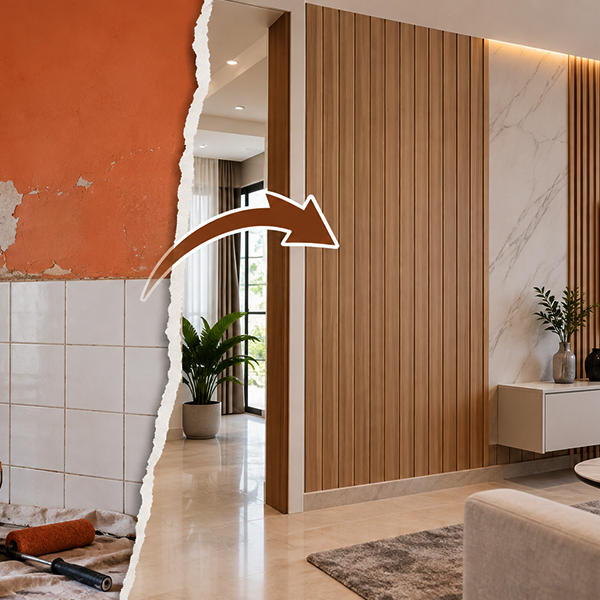
PVC Wall Panels: Why Are Homeowners Replacing Paint and Tiles With Them?
For many Jaipur homeowners, wall finishing is no longer only about choosing a colour or tile pattern. It is also about moisture, maintenance, installation time, durability, and how easily a room can be refreshed. That is why PVC wall panels are gaining attention as an alternative to painted walls and selected tiled surfaces. PVC wall panels are finished interior panels made from polyvinyl chloride (PVC), a plastic material widely used in construction. The US EPA describes PVC as a rigid or flexible plastic with resistance to grease, oil, and chemicals. For homes in Jaipur and across India, the appeal is practical: a decorative wall surface that can be easy to clean, moisture-resistant, and available in multiple finishes.
What Are PVC Wall Panels and Where Are They Used?
PVC wall panels are pre-finished panels installed over suitable wall surfaces to create a decorative and protective interior finish. Depending on the design, they can provide wood-like, textured, fluted, marble-inspired, or contemporary appearances.
Polywood’s PVC wall-panel range is intended for residential and commercial applications and is offered in thicknesses from 6 mm to 12 mm. The company states that its panels are non-porous and non-absorbent and designed to resist water, moisture, chemicals, termites, and everyday wear.
Typical applications include living rooms, bedrooms, kitchens, bathrooms, offices, hotels, and restaurants.
Why Are PVC Wall Panels Replacing Paint and Tiles?
The biggest reason is the search for a balance between appearance and day-to-day practicality. Paint is versatile and easy to refresh, but walls may need periodic touch-ups, particularly in busy or moisture-prone areas. Tiles are durable and familiar, but they generally involve grout, more involved installation, and a heavier visual treatment.
PVC wall panels sit between these choices. They create a finished surface without repeated painting, while modern designs can reproduce the look of wood, stone, or other materials.
1. Low-Maintenance Walls
Polywood states that its PVC panels do not require paint, varnish, or polish and are easy to clean. For families, rental properties, offices, and high-use spaces, reducing recurring surface-maintenance work can be a meaningful benefit.
This does not mean zero care. Dust, stains, joints, and edges still need sensible cleaning, and installation quality matters.
2. Strong Moisture Resistance
Moisture matters in kitchens, bathrooms, utility areas, and walls affected by damp conditions. Polywood describes its PVC wall panels as waterproof, moisture-resistant, non-porous, and non-absorbent.
However, a water-resistant finish does not fix the source of wall seepage. Active plumbing leaks, rising damp, or structural moisture should be addressed before covering the wall.
3. A Quicker-Looking Interior Transformation
Panel systems can refresh a room without relying on repeated coats of paint. Polywood also notes that its panels can be uninstalled when relocation is required. Actual installation time depends on wall condition, area, pattern, access, and the installer.
4. More Texture and Character Than Plain Paint
Paint mainly changes colour and sheen. Wall panels can change colour, texture, depth, and visual character. That makes them useful for accent walls, TV backdrops, bedrooms, reception areas, and contemporary interiors.
Polywood’s current portfolio includes PVC wall and ceiling panels, fluted panels, Muraux luxury wall panels, and soffit systems. Homeowners comparing PVC wall panel designs can therefore choose between subtle finishes and more prominent feature-wall styles.
5. Practical Performance for Selected Interiors
The US EPA identifies PVC as resistant to grease, oil, and chemicals. For some interior applications, that can support easier routine care compared with more vulnerable decorative surfaces.
Suitability still depends on the exact panel and location. Not every PVC product should be treated as suitable for every wet, heated, exterior, or high-risk environment.
Are PVC Wall Panels Better Than Paint or Tiles?
PVC wall panels are not universally better; they are often better for homeowners who prioritise low maintenance, moisture resistance, decorative variety, and a relatively straightforward interior upgrade.
| Factor | PVC Wall Panels | Paint | Tiles |
| Maintenance | Generally low | Periodic touch-ups | Surface care plus grout |
| Moisture suitability | Strong for suitable products | Depends on paint/system | Strong when correctly selected |
| Design | Textures and patterns | Broad colour choice | Broad patterns and finishes |
| Installation | Panel-based | Preparation, coats, drying | More labour-intensive |
| Replacement | Panels may be replaceable | Repaint affected area | Damaged tiles may be replaced |
| Best fit | Decorative upgrades and practical wall coverage | Simple colour changes | Traditional tiled applications |
This is a practical comparison rather than a claim that every product performs identically. Specifications and installation systems vary by manufacturer.
What Should You Check Before Buying PVC Wall Panels?
Start with the room, not the pattern. Confirm the panel is intended for the application, check thickness and dimensions, inspect finish quality, and ask how corners, joints, edges, sockets, and access points will be handled.
For Jaipur homes, inspect existing walls for seepage, cracks, dampness, or loose plaster before installation. A good panel cannot compensate for an unhealthy substrate.
Also compare complete project cost, not only panel price. Panels, profiles, adhesives or fixings, cutting, labour, surface preparation, and finishing accessories can affect the final budget. Polywood lists accessories for joints, corners, and edges in some panel systems.
For style-focused rooms, fluted wall panels can work well as an accent treatment, while simpler PVC finishes may be more suitable for broader wall coverage.
Where Does Polywood Fit In?
For homeowners researching PVC wall panels in Jaipur, Dhabriya Polywood Ltd. is based in Jaipur and offers a broader wall-and-ceiling panel portfolio. Its website lists PVC, fluted, Muraux, and soffit panel systems and gives its Jaipur address in Malviya Industrial Area.
Its published PVC wall-panel information highlights residential and commercial use, multiple designs, low maintenance, moisture resistance, and customisation. As with any interior-material purchase, verify the exact panel specification and installation method for your project instead of choosing on brand name alone.
Common Mistakes to Avoid
Do not install panels over active seepage and assume the problem is solved. Do not choose only by appearance without checking the intended application. Avoid skipping measurements, because wastage can affect the budget. Finally, do not ignore installation quality: poor alignment, weak joints, or badly finished corners can make a good panel look inferior.
Conclusion
PVC wall panels are becoming a practical alternative to paint and, in selected applications, tiles because they combine decorative flexibility with low maintenance and moisture resistance. For Jaipur homeowners, they can be especially useful when the goal is a clean, modern wall finish without repeated repainting. The smartest approach is to choose by room, substrate, installation system, and long-term maintenance needs—not by design alone.
FAQs
- Are PVC wall panels better than paint?
For homeowners prioritising low maintenance, moisture resistance, and textured designs, PVC wall panels can be more practical than paint. Paint remains a strong choice when simple colour changes and lower-complexity decorating are the priority. - Are PVC wall panels waterproof?
Suitable PVC wall panels can be waterproof and non-absorbent. Polywood specifically describes its PVC wall panels as waterproof, moisture-resistant, non-porous, and non-absorbent. - Can PVC wall panels be used in bathrooms and kitchens?
They can be suitable for moisture-prone interiors when the specific product is designed for that application and installed correctly. They should not be used to hide unresolved leakage or structural dampness. - Do PVC wall panels require painting or polishing?
Polywood states that its PVC wall panels do not require paint, varnish, or polish and are designed for easy maintenance. - How thick are Polywood PVC wall panels?
Polywood currently lists PVC wall-panel thicknesses of 6 mm, 7 mm, 8 mm, 9 mm, 10 mm, and 12 mm. - Are PVC wall panels suitable for Jaipur homes?
They can be a practical option for Jaipur interiors where homeowners want moisture resistance, easy maintenance, and decorative flexibility. The final choice should still consider wall condition, room type, installation method, and the exact panel specification.