
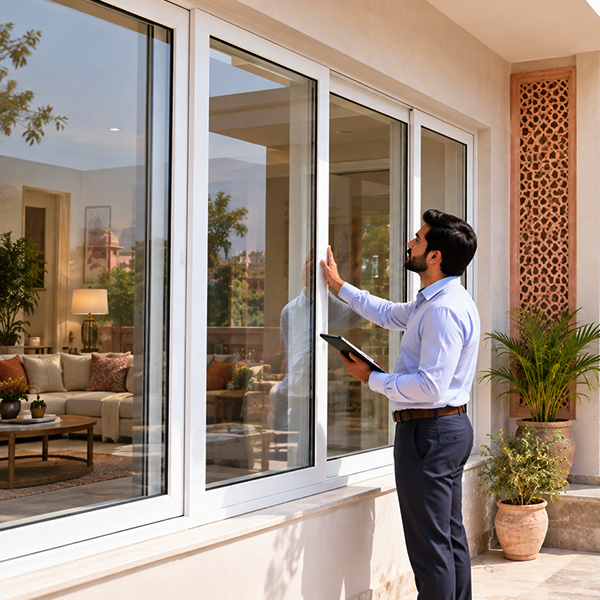
Best uPVC Doors and Windows in Jaipur? Don’t Buy Until You Check These 7 Things
Choosing the Best uPVC Doors and Windows in Jaipur is not simply about comparing prices or picking the most attractive design. The right system has to handle Jaipur’s heat, dust, seasonal rain, daily usage, and long-term maintenance while still complementing your home or commercial space.
That is why two products that look almost identical in a showroom can perform very differently after installation. Profile quality, reinforcement, glass, hardware, sealing, installation and after-sales support all matter. uPVC profiles for windows and doors are covered by Indian Standard IS 17953:2023, while BIS also recognizes testing methods related to thermal performance, air permeability, water penetration and mechanical performance.
Before you sign a quotation, check these seven factors.
How do you choose the Best uPVC Doors and Windows in Jaipur?
The best choice is the one that balances material quality, energy performance, durability, security, design, installation quality and after-sales support. A lower initial quote is not necessarily better value if it uses weaker profiles, unsuitable glass or poor installation.
Here are the seven checks that deserve your attention.
1. Check the uPVC profile quality
The profile is the foundation of your window or door. Ask the manufacturer about the profile specifications, material composition, available sizes and whether the product is designed for the required application.
A useful benchmark is compliance with IS 17953:2023, the BIS standard covering uPVC profiles for windows and doors. The BIS product manual also specifies testing and certification procedures for compliant profiles.
For a Jaipur property, also consider the frame’s resistance to everyday dust, moisture and outdoor exposure. Do not judge profile quality only by thickness or appearance; the complete system matters.
For homeowners comparing designs, options such as uPVC windows and doors can make it easier to evaluate different opening styles and applications before selecting a configuration.
2. Don’t ignore the glass
A high-quality frame paired with unsuitable glass can limit the overall performance of the opening.
Ask whether the quotation includes single, double or another glazing configuration, and understand the purpose of the selected glass. Glazing influences heat transfer, solar heat gain, daylight and comfort. India’s building-efficiency guidance evaluates fenestration using factors such as U-factor, solar heat gain coefficient (SHGC) and visible light transmittance (VLT).
For Jaipur homes with strong sun exposure, discuss the glass according to room orientation, shading and air-conditioning requirements rather than automatically choosing the cheapest option.
The goal is not simply “more glass” or “double glass”; it is choosing the right glazing combination for the building.
3. Examine reinforcement, hardware and security
A door or window is only as reliable as the components that allow it to operate safely every day.
Ask what reinforcement is used where required, and inspect hinges, locks, rollers, handles and other hardware. Test the sample yourself. Does it open smoothly? Does the sash close evenly? Does the locking mechanism engage properly?
Security should be considered at the system level rather than by looking at the lock alone. Frame design, hardware, glazing and installation all contribute to how secure the final opening feels.
For larger openings, sliding systems and frequently used entrances, hardware quality becomes especially important because repeated operation places greater demands on moving components.
4. Check air, water and weather performance
What is the point of a premium window if dust, rain or outside air easily enters around the edges?
BIS standards include specific testing methods for air permeability and water penetration, while newer standards also address wind resistance and classification of doors, windows and sliders.
This is why sealing details deserve attention. Ask about gaskets, drainage arrangements, corner fabrication and installation joints.
For Jaipur, where outdoor dust and strong seasonal weather can affect comfort, a properly sealed opening can be much more practical than a product chosen purely for its appearance.
5. Compare thermal and acoustic performance
A good window should contribute to indoor comfort, not merely divide indoor and outdoor spaces.
Thermal performance depends on the complete assembly, including frame and glazing. BEE guidance uses measures such as U-factor and SHGC when evaluating fenestration performance.
Acoustic performance also deserves attention if the property is near a busy road, commercial area or other sources of outside noise. Ask the supplier what glass and configuration are appropriate for your specific requirement rather than relying on generic claims such as “soundproof.”
For some projects, a well-selected configuration can provide a better balance between daylight, heat control, ventilation and noise reduction.
6. Look beyond the product catalogue: installation matters
Even a technically good window can underperform when installed poorly.
Before buying, ask who will measure the openings, how the frames will be anchored, how gaps will be sealed and whether the installation team is trained for the specific system.
Measurements should be accurate, frames should be properly aligned, and perimeter sealing should be completed carefully. This is especially important during replacement projects where existing openings may not be perfectly square.
Dhabriya Polywood’s product range includes multiple configurations such as sliding, casement, tilt-and-turn/top, combination, fixed, bay and villa windows, illustrating why the installation approach should be matched to the selected design.
For entrance and balcony applications, uPVC casement doors can be explored when you need a hinged configuration with a different operational and design requirement.
7. Compare warranty, service and long-term value
Finally, look beyond the quotation total.
Ask what the warranty covers, which components are included, how service requests are handled and whether replacement hardware is available. Clarify exclusions before signing.
Also compare the complete quotation: frame, glass, hardware, reinforcement where applicable, installation, transportation and taxes. Two quotes with different specifications should never be compared only on the final price.
Dhabriya Polywood lists its Jaipur base at Malviya Industrial Area and offers a broad windows-and-doors portfolio, making local accessibility another practical factor buyers may consider when evaluating suppliers.
What mistakes should buyers avoid?
The most common mistake is choosing based on appearance and price alone. Other avoidable mistakes include accepting vague technical specifications, ignoring glass selection, failing to inspect hardware, comparing incomplete quotations and assuming installation quality is identical across suppliers.
A better approach is simple: compare the complete system, ask for specifications in writing, inspect samples, understand what is included in the quote and evaluate the supplier’s service capability.
Conclusion
Finding the Best uPVC Doors and Windows in Jaipur starts with asking better questions. Check the profile, glazing, reinforcement and hardware, weather sealing, thermal and acoustic requirements, installation quality, and warranty support before making a decision.
The best product is not necessarily the cheapest or the most decorative. It is the one whose specifications match your property, whose installation is handled properly, and whose supplier can support the system over the long term. A careful comparison today can prevent expensive replacement or performance problems later.
FAQs
1. Are uPVC windows suitable for Jaipur’s climate?
Yes. uPVC systems can be considered for Jaipur homes and commercial buildings, provided the profile, glazing, sealing and installation are selected appropriately for the location and application.
2. What should I check before buying uPVC windows?
Check profile quality, glazing, reinforcement, hardware, air and water sealing, thermal performance, installation and warranty terms. These factors together determine real-world performance.
3. Is double glazing always better than single glazing?
Not automatically. Double glazing can provide different thermal and acoustic benefits, but the right choice depends on glass type, orientation, shading, room requirements and the building’s overall design. BEE guidance evaluates fenestration using factors including U-factor and SHGC.
4. How important is uPVC window installation?
Very important. Incorrect measurement, alignment or sealing can reduce the performance of an otherwise good window or door system.
5. How can I compare two uPVC window quotations?
Compare the complete specification rather than the final price. Check profile specifications, glass, hardware, reinforcement, installation, warranty, taxes and any exclusions.
6. Does BIS have a standard for uPVC window profiles?
Yes. BIS lists IS 17953:2023 as the specification for uPVC profiles for windows and doors.
7. What types of uPVC windows are available?
Common configurations include sliding, casement, fixed, combination, bay, villa, arch and other specialized designs. The suitable type depends on ventilation, space, aesthetics and usage.